 01953 609930




Premier Control Technologies Fluid Solutions
Fluid Metering, the inventors of valveless rotating piston pump technology, have introduced the FENYX® pump—a compact, high-precision solution designed for accurate and repeatable dispensing.
However, with so many pump technologies available and the person responsible for PLC programming often not having a mechanical engineering background, integration can take longer than expected.
While consulting a specialist is always an option, many teams work in different ways—some may prefer a video call, others an in-person visit, a phone conversation, or a simple email exchange. For others, independent research is preferred, but information is not always readily available.
This white paper aims to shorten the integration time for the FENYX® variable dispense pump, which uses valveless rotating piston pump technology—a design that’s less commonly known—and ensure it operates at its best. A great pump is only as good as its control system.
Piston pumps are known for their accuracy due to the fixed volume dispensed per stroke. For comparison, peristaltic are “less” accurate because they rely on flexible tubing, which introduces tolerance variability.
Standard piston pumps, such as OEM syringe pumps, and micro piston pumps require valves—this adds mechanical complexity and reduces component lifespan. They also operate in two stages: aspiration and dispense. In contrast, the rotating piston pump aspirates and dispenses continuously, simplifying the system and increasing throughput.
The Fluid Metering design improves on traditional piston pumps by combining rotation with reciprocation. The piston rotates and moves up and down, drawing fluid into a defined cavity and pushing it out—over and over. This eliminates the need for auxiliary valves, maintaining piston-level accuracy while simplifying control.
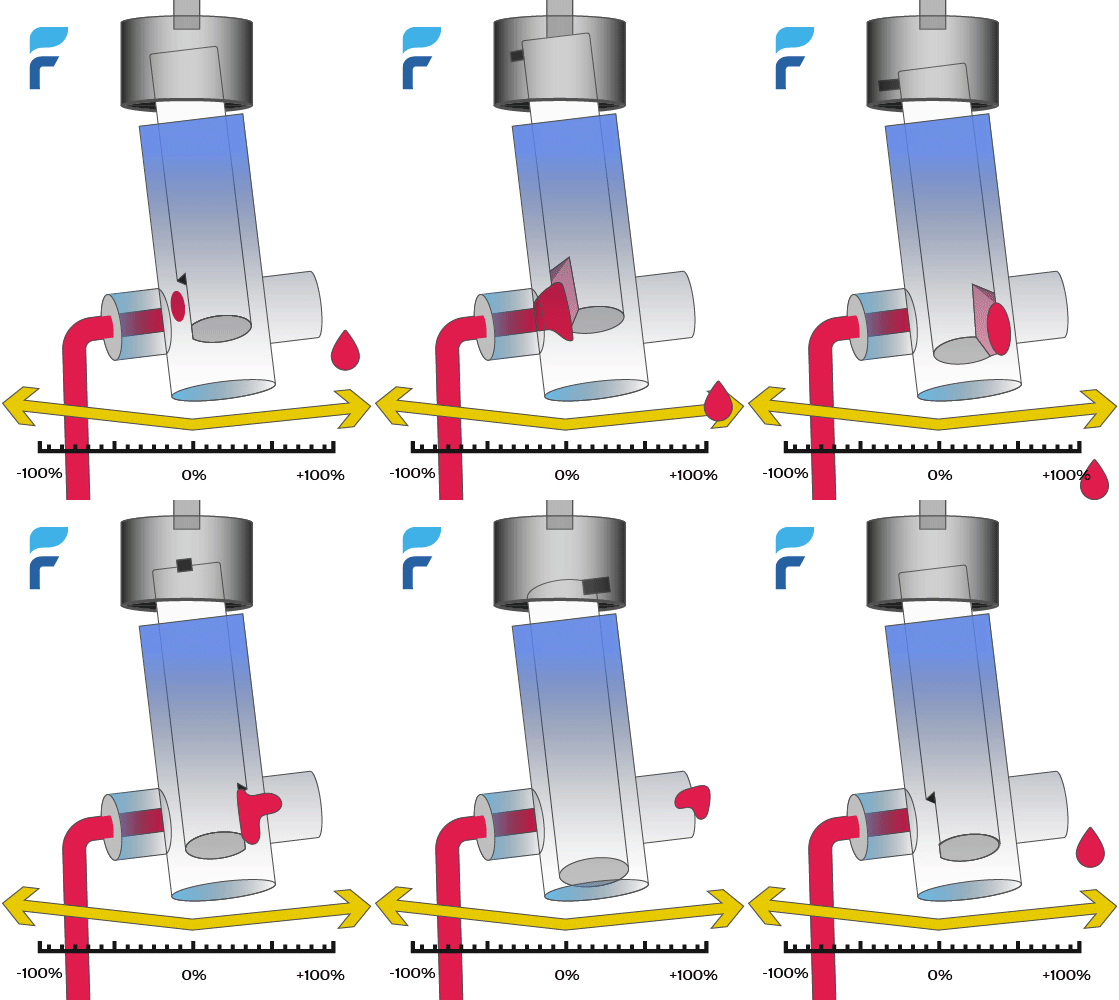
The valveless pumping function is accomplished by the synchronous rotation and reciprocation of the ceramic piston in the precisely mated ceramic cylinder liner. One complete piston revolution is required for each suction/discharge cycle as shown. The piston always bottoms for maximum fluid and bubble clearing.
The piston rotates and reciprocates. As the piston is pulled back and the piston flat opens to the inlet port, suction is created and the fluid fills the pump chamber. As the piston reaches the highest point in the reciprocation cycle, the pump chamber is now at its maximum volume capacity.
Continuing the rotation, the inlet port is then sealed and crossover occurs. As the inlet port is sealed and the pump chamber is full, the outlet port opens up. Only one port is open at any time and at no time are both ports interconnected.
Continuing the rotation and reciprocation, the piston is forced down and the piston flat opens to the outlet port. Discharge is created and fluid is pumped out. The piston bottoms for maximum fluid and bubble clearing.
Continuing the rotation, the outlet port is then sealed and crossover occurs. As the outlet port is sealed and the pump chamber is empty, the inlet port opens to start another suction stroke. Only one port is open at any time and at no time are both ports interconnected.
| Feature | Benefit |
|---|---|
| Accurate, repeatable output | Ideal for metering and dosing applications |
| Extensive choice of wetted materials | Prolongs pump life and service intervals |
| Small footprint | Saves installation space |
| Simple, compact design | Reduces acquisition and maintenance costs |
| No valves to clog or leak | Improves uptime, reduces failure points |
| Output independent of viscosity | Maintains accuracy despite changing conditions |
| Self-priming to 4.5 metres | Simplifies system installation |
| Wide choice of motors and drives | Easily adapted for specific applications |
FENYX® pumps can run for 80 million+ cycles (depending on application) without needing recalibration—significantly reducing consumables and calibration overhead.
Rotating piston pumps provide exceptional accuracy, particularly at low volumes. This is measured using the Coefficient of Variation (Cv), a common metric in precision dosing:
Cv(%) = (σ/ μ) x 10
Where:
Lower Cv = Higher accuracy and consistency
Interpretation:
Dispensed volume is controlled in two ways:
The stroke length is controlled by the angle of the pump head relative to the drive shaft:
This adjustment is infinitely variable between 0–100%. The design ensures the piston always bottoms out, eliminating air bubbles—especially critical at low dispense volumes.
Previously, stroke adjustments had to be done manually or were fixed. The Fenyx pump automates this via a stepper motor with encoder, allowing stroke length to be adjusted programmatically.
For accurate dispensing, the rotational stepper motor must complete a full revolution. The two stepper motors involved are:
The linear actuator resolution must not be exceeded. Overdriving can damage the pump. The encoder at the end of the actuator provides positional feedback. The pump is shipped pre-calibrated, and Fluid Metering will provide the default settings.
The “parked position” is when the piston is nearly touching the top of the pump chamber. This minimises residual volume when pump is not in operation.
Each dispense cycle should start and stop at defined motor positions. A flag sensor provides rotational feedback. Standard sensors are available, but custom options can be provided to match specific PLC platforms.
FENYX® makes priming simple, even for small-volume applications:
Line-fill detection methods include:
The optimal method depends on your system. Flow meters are often overkill, as Fenyx does not need recalibration. “Blind dispensing” (based on timing or revolutions) may be sufficient.
The pump head can operate dry for short periods only—i.e., with no liquid inside.
FENYX® pumps are bidirectional:
FENYX® can be controlled by Fluid Metering’s stepper controller or any PLC-compatible stepper driver. Most PLC integrators prefer their own brand of driver. Controller selection is outside the scope of this document.
This guide assumes the correct pump head, piston size, and wetted materials have already been selected for your application.
Changes in suction and discharge pressure will affect flow performance. Consult the flow curve to anticipate these changes in your system design.
We recommend using our evaluation kit, which includes:
This enables initial testing and integration before transitioning to your preferred PLC controller.
| Piston Size | Volume/Step |
|---|---|
| 3/16” | 0.013 µL/step |
| 1/4” | 0.037 µL/step |
| 9 mm | 0.079 µL/step |
If you know the piston size, you can calculate dispense volume per step based on actuator position.
| Piston Size | Volume/Step |
|---|---|
| 3/16” | 0.013 µL/step |
| 1/4” | 0.037 µL/step |
| 9 mm | 0.079 µL/step |
The linear stepper motor includes an encoder, and the rotational motor uses a flag sensor to determine position. Once you know both motor positions, you can calculate the dispense volume. Dispense rate is controlled by rotational speed and stroke length (angle).
We aim to respond within 1 hour for customer enquiries

Call us
01953 609930

Email us
sales@pctflow.com
PCT are a leading UK distributor and your enquiry will be handled with the utmost professionalism. Please provide your details below.